
All You Need to Know about Die Rubber
Die rubber (die injection rubber) plays a crucial role in the die-making industry and on a piece of cutting die. Today, we will explore this core die component through two aspects: the function of die rubber in die-making and how die-makers cut the die rubber based on the pattern shape of the die design.
So, what are the primary functions of die rubber in cutting dies?
First and foremost, its primary and most critical function is to eject scrap and separate the finished product from waste material. High-quality die rubber possess exceptional elasticity and recovery properties. When compressed during stamping, they rapidly rebound and expand once pressure is released. This rebound force evenly propels trapped products and scrap out from between the die teeth, allowing them to settle smoothly onto the material substrate—achieving a clean separation. Without die rubber during die fabrication, material becomes tightly lodged in the die, requiring manual removal. This process is highly inefficient and prone to snagging or breaking delicate products, rendering automated continuous die-cutting production impossible.
Second, die rubber effectively protects die blades and cutting edges. Typically, cutting dies exhibit high precision. Installing a spring pad effectively reduces the impact force on the die blades during die-cutting machine operation, significantly extending the service life of the entire die. The spring pad provides a soft cushioning layer between the die and the rigid die-cutting machine base plate. It absorbs most of the impact force and stress during punching, preventing the die tips from directly striking the hard platform. This prevents chipping, curling, or deformation of the cutting edges.
Third, die rubber ensures uniformity during die cutting. After installing die injection rubber, the cushion provides moderate and even support for the material being cut. When the blade penetrates the material, it continues to cut into the cushion to a certain depth. This guarantees complete penetration even with slight thickness variations in the material, preventing defects like double-cutting or rough edges.
Fourth, die rubber significantly enhances cutting precision. Both the die platform and the die itself may exhibit minor surface irregularities. The elasticity of the cushion compensates for these slight deviations, ensuring consistent cutting pressure across the entire die surface. This guarantees stable cutting quality.
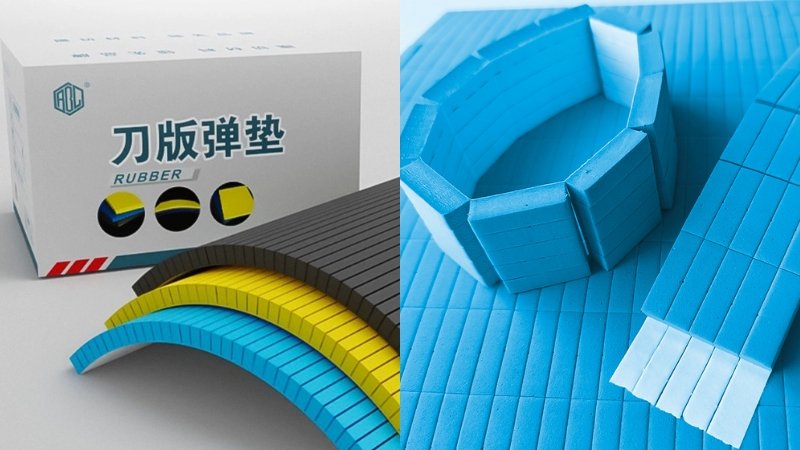
In most market scenarios, many die-shop and die-maker purchase boxed die rubbers, strip-shaped die rubber for direct installation onto die boards. However, this standardized strip-shaped die rubber is only suitable for straight, linear die patterns. For complex die shapes, custom cutting equipment is required to shape the die rubber pattern. This ensures consistent rebound force across the entire die during punching, guaranteeing uniform cutting results. So, what equipment can be used for die rubber cutting? We primarily recommend three types:
CO2 Laser Cutting Machine: CNC-controlled laser cutters can precisely cut rubber according to your design. They offer high speed and efficiency. The sole drawback is thermal processing, which may scorch the rubber edges, causing material deformation, vulcanization hardening, and other issues.
Waterjet cutting machine: AOLANG LASER has developed a specialized waterjet cutter for die rubber cutting, also CNC-controlled. It handles thick materials with cold cutting, preventing deformation, thermal effects, or vulcanization issues. For details, visit our product page.
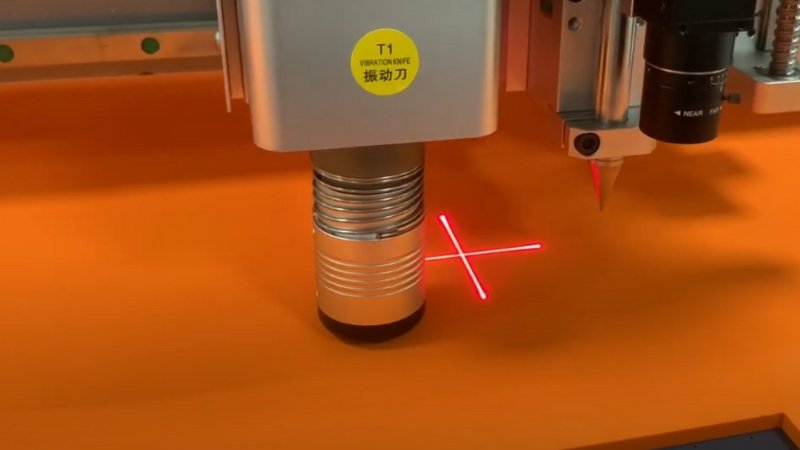
Vibration cutting machine: Vibration cutter,Primarily recommended for corrugated box sample-making, it can also be used for die rubber cutting. It performs cold cutting according to graphic designs. While its efficiency is theoretically lower than waterjet cutting, its greatest advantage lies in versatile applications. If you require die rubber cutting alongside box sample-making, please visit our product details page.